Esports has grown from casual gaming into a serious digital competition space where teamwork, planning, discipline, and community all matter. The topic projectrethink org team esports reflects this modern side of gaming, where competitive play is not only about individual skill but also about team structure, training, leadership, and long-term development. For readers who want to understand how esports teams work and why platforms like ProjectRethink discuss them, this guide explains the idea in a clear and practical way.
What Is projectrethink org team esports?
projectrethink org team esports refers to the esports-focused content connected with ProjectRethink.org, where gaming, teamwork, technology, and competitive development are discussed together. Instead of presenting esports only as entertainment, the topic looks at how organized teams can grow through planning, coaching, communication, and responsible gaming culture.
In modern esports, a team is more than a group of players sitting behind screens. A strong team often includes players, coaches, analysts, managers, content creators, and support staff. Each role helps the team improve performance, build a public image, connect with fans, and prepare for future opportunities. This is why projectrethink org team esports can be understood as a broader discussion about competitive gaming culture rather than just one match, one roster, or one tournament.
Why Esports Teams Matter Today
Esports teams matter because competitive gaming has become highly structured. Players now train for hours, study opponents, review strategies, and build communication systems much like traditional sports teams. Games such as League of Legends, Valorant, Counter-Strike, Mobile Legends, Fortnite, Dota 2, and many others have shown that winning depends on both talent and teamwork.
The rise of esports has also created career paths for young gamers. A skilled player may become a professional competitor, streamer, coach, analyst, event host, or gaming content creator. This makes esports more than a hobby for many people. It becomes a digital career field where discipline and smart planning are important.
The idea behind projectrethink org team esports fits this larger movement because it focuses on team growth, community, and the changing future of competitive gaming. It also highlights the need for balance, training, and responsible participation in gaming spaces.
Team Structure in Competitive Gaming
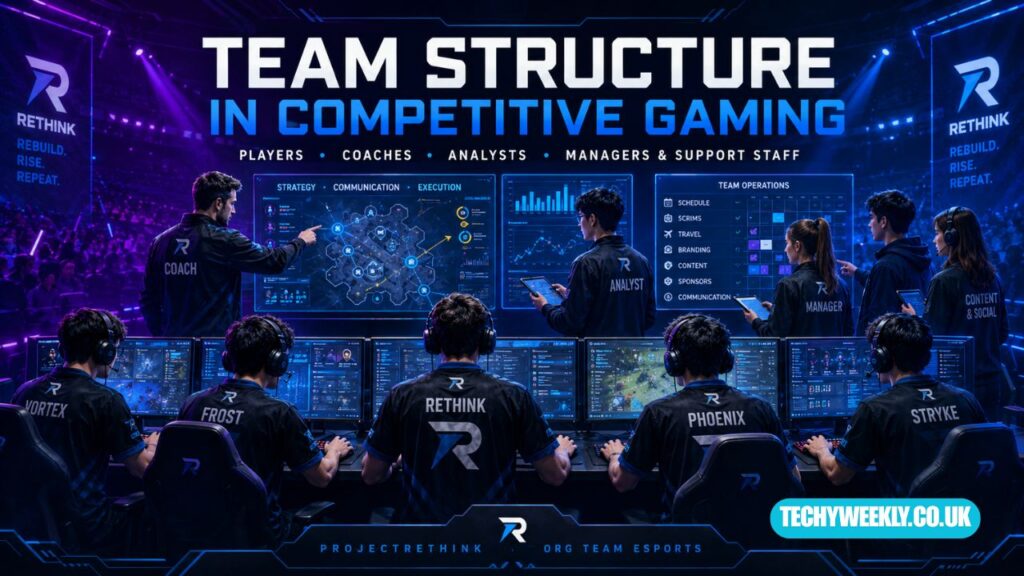
A successful esports team usually needs more than skilled players. Every role has a purpose, and the best teams understand how to use those roles correctly.
Players
Players are the main performers. They compete in matches, practice strategies, improve mechanics, and build chemistry with teammates. In team-based games, communication is often just as important as aim, speed, or game knowledge. A talented player who cannot work with others may struggle in a serious esports environment.
Coaches
Coaches guide the team’s training and strategy. They study performance, correct mistakes, plan practice schedules, and help players stay focused. In many esports scenes, coaches also help with mindset, team discipline, and preparation before important matches.
Analysts
Analysts study gameplay data, opponent habits, map control, pick-and-ban patterns, and performance trends. Their job is to turn information into useful strategy. This is one reason technology has become so important in esports. Data can help teams understand what they are doing well and where improvement is needed.
Managers and Support Staff
Managers handle schedules, communication, travel plans, sponsorship discussions, and team organization. Support staff may also help with content, social media, fan engagement, health routines, and brand building. A team without good management can face problems even when the players are talented.
Training and Player Development
Training in esports is not only about playing more games. Serious teams follow a planned routine. This may include individual skill practice, team scrims, match reviews, strategy sessions, replay analysis, and communication drills. The goal is to improve both personal performance and team coordination.
projectrethink org team esports is closely connected with this idea of development. A good esports team grows when players learn from mistakes, understand their roles, and build trust with each other. Training also helps players manage pressure during important matches, where one wrong decision can change the result.
Physical and mental habits are also becoming more important. Long gaming sessions can affect posture, sleep, focus, and stress levels. Professional teams increasingly understand that healthy players perform better. This means rest, exercise, mental focus, and balanced routines are now part of serious esports preparation.
Technology and Strategy in Esports
| Technology / Strategy Area | How It Helps Esports Teams | Practical Example | Relation to projectrethink org team esports |
|---|---|---|---|
| Advanced Gaming Hardware | Helps players perform with better speed, accuracy, and comfort during practice and matches. | Gaming PCs, high-refresh monitors, mechanical keyboards, gaming mice, and headsets. | Shows how professional tools support better team performance. |
| High-Speed Internet | Reduces lag and improves smooth communication during online matches. | Stable broadband, low ping connection, and backup internet support. | Helps teams compete more reliably in fast-paced games. |
| Communication Tools | Allows players, coaches, and managers to coordinate quickly during training and matches. | Voice chat, team calls, strategy channels, and private team servers. | Supports teamwork, planning, and real-time decision-making. |
| Performance Software | Tracks player improvement, mistakes, and match results over time. | Stats dashboards, aim trackers, match reports, and training tools. | Connects esports success with data-based improvement. |
| Replay Systems | Helps teams review past matches and identify errors or strong plays. | Watching match replays, reviewing team fights, and studying decision-making. | Helps players learn from experience and improve future performance. |
| Map Knowledge | Gives teams better control over positioning, movement, and objective planning. | Understanding map zones, rotations, hiding spots, and attack routes. | Shows why strategy is as important as mechanical skill. |
| Timing and Rotations | Helps teams move at the right moment and avoid poor decisions. | Rotating to objectives, timing attacks, and avoiding risky fights. | Builds smarter gameplay and stronger coordination. |
| Character Roles | Helps every player understand their duty inside the team. | Support, entry fragger, sniper, tank, healer, controller, or captain roles. | Makes team structure clearer and more organized. |
| Opponent Analysis | Helps teams predict enemy behavior and prepare better strategies. | Studying opponent habits, favorite maps, weak points, and common plays. | Adds tactical thinking to competitive gaming. |
| Digital Fan Platforms | Helps teams grow their audience and build a stronger identity. | Live streams, match highlights, interviews, short videos, and social posts. | Connects the team with fans and builds community trust. |
| Content Creation | Turns team activity into engaging material for followers. | Behind-the-scenes videos, training clips, player stories, and event updates. | Makes esports teams more visible and memorable. |
| Streaming Platforms | Allows fans to watch matches and interact with players in real time. | YouTube streams, Twitch broadcasts, live chats, and tournament coverage. | Strengthens the connection between players and supporters. |
Technology has changed how teams train and compete. Players use advanced gaming hardware, high-speed internet, communication tools, streaming platforms, performance software, and replay systems. These tools help teams prepare more effectively and connect with audiences around the world.
Strategy is another major part of competitive gaming. Teams must understand maps, timing, character roles, economy systems, rotations, team fights, and opponent behavior. In some games, a smart strategy can beat raw mechanical skill. That is why projectrethink org team esports can be connected with both gaming knowledge and tactical thinking.
Esports teams also use digital platforms to grow their audience. Match highlights, behind-the-scenes videos, training clips, player interviews, and live streams help fans feel closer to the team. This fan connection can become a major part of a team’s identity.
Community and Fan Engagement
A strong esports team does not exist only inside competitions. It also grows through community. Fans support teams, follow players, watch live matches, share clips, buy merchandise, and join online discussions. This relationship between teams and fans helps esports feel alive and interactive.
projectrethink org team esports also points toward the value of inclusive gaming spaces. Esports communities are strongest when new players feel welcome and when fans can participate without toxic behavior. Good community culture encourages learning, respect, and fair competition.
Local gaming events, online tournaments, Discord communities, school esports clubs, and social platforms all help build this connection. For younger players, community support can be the first step toward learning teamwork and competitive discipline.
Responsible Gaming and Player Wellbeing
One important part of esports growth is responsible gaming. Competitive gaming can be exciting, but balance matters. Players need to manage screen time, stress, sleep, and emotional pressure. Serious competition can create anxiety, especially when players face criticism, public attention, or repeated losses.
A healthy esports environment supports players beyond match results. This may include team check-ins, mental health awareness, rest periods, positive coaching, and respectful communication. Winning is important, but long-term development is stronger when players are supported as people.
projectrethink org team esports can be viewed through this lens because modern esports is not only about competition. It is also about building better systems for players, teams, and communities.
Career Opportunities in Esports
The esports industry offers many possible paths. Not everyone needs to become a professional player to build a future in gaming. Some people work as coaches, shoutcasters, analysts, tournament organizers, social media managers, video editors, designers, streamers, writers, and event coordinators.
This makes esports attractive for students, gamers, and digital creators. A person who understands gaming culture can use those skills in different ways. Team esports teaches communication, quick decision-making, leadership, problem-solving, and adaptability. These skills can be useful both inside and outside gaming.
projectrethink org team esports is useful as a topic because it helps readers think beyond simple gameplay. It shows esports as an organized field where teamwork, planning, and personal growth all matter.
Challenges Facing Esports Teams
Esports teams face several challenges. Competition is intense, and only a small number of players reach the highest professional level. Teams also need funding, management, consistency, and a clear identity. Without these, even talented teams may struggle to survive.
Another challenge is burnout. Players who practice too much without balance may lose motivation or suffer from stress. Online criticism can also affect confidence. Teams must learn how to handle pressure and protect player wellbeing.
There is also the challenge of constant change. Games receive updates, new strategies appear, and player performance can shift quickly. A team that wants to stay competitive must keep learning. In this way, projectrethink org team esports connects with the wider reality of esports: growth requires flexibility.
Future of Team Esports
The future of esports looks strong because gaming continues to attract global audiences. More schools, colleges, brands, and communities are paying attention to competitive gaming. As technology improves, esports may become even more interactive through better streaming, virtual events, performance tools, and fan experiences.
Team esports will likely continue to grow around coaching, analytics, wellness, and community. Players will need more than fast reactions. They will need discipline, teamwork, emotional control, and the ability to adapt. Organizations that understand these areas will be better prepared for long-term success.
projectrethink org team esports fits into this future by highlighting the broader meaning of competitive gaming. It shows that esports can include skill, structure, education, entertainment, and community impact at the same time.
Conclusion
projectrethink org team esports is a valuable topic for understanding how modern competitive gaming works. It brings together teamwork, player development, coaching, technology, strategy, fan engagement, and responsible gaming. Esports is no longer just about playing for fun; it has become a structured field where preparation and community matter.
For readers interested in gaming, esports teams, or digital competition, this topic offers a clear view of how the industry is changing. The strongest teams are not built only on individual talent. They are built on trust, training, leadership, health, and a shared purpose. That is what makes team esports such an important part of the gaming world today.
FAQs
What is projectrethink org team esports?
projectrethink org team esports refers to esports-related content connected with ProjectRethink.org, focusing on teamwork, training, gaming culture, and competitive development.
Is esports only about professional players?
No, esports includes many roles such as players, coaches, analysts, managers, streamers, editors, and tournament organizers.
Why is teamwork important in esports?
Teamwork helps players communicate better, follow strategies, support each other, and perform well under pressure during competitive matches.
Can esports become a career?
Yes, esports can lead to careers in professional gaming, coaching, content creation, event management, analysis, and digital media.
Why is player wellbeing important in esports?
Player wellbeing matters because stress, burnout, poor sleep, and long screen time can affect performance, focus, and long-term growth.
You May Also Read: Latest Gaming PlayMyWorld: A Complete Guide for Modern Online Gamers